The project I am currently focusing on is centred around a set of love letters that document a broken relationship I found concealed in some books in a charity shop. Considering the unique nature of this material, researching the Museum of Broken Relationships, a collection of personal artefacts coming from relationships that have fallen apart, feels relevant, as the material I am working with is similar to the materials stored in the museum.
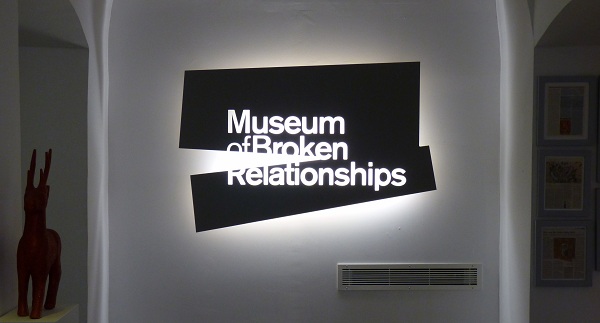
The Museum of Broken Relationships sits between being a museum and an artwork. A collection of heartbreak memorabilia catalogued and displayed as a way for the artists who organised it, the donors of the artefacts and the general public to process their own heartbreak, an emotion that is rarely dealt with in a public forum.
One exhibit shown in the museum is a blinking red collar light, stored in a room titled “Resonance of Grief”. In a heartbreaking, emotionally intense description, the donor says, “My former partner took her own life a little over a year after we split up. Alone, in a hotel room. In a strange town. I am still alive, but… PS Please hang it blinking if you use it – it reminds me of a heartbeat. The battery can be replaced”.
Mary Hammond describes the collar: “After reading the personal story accompanying the object, the otherwise innocuous blinking light took on a new meaning, and I could feel the rhythm of it like a heartbeat now blinking on into eternity as a reminder of the lost life it represented … The object itself became re-filled with meaning and its material presence affected me with each flash of light. This affective potential is what makes the Museum of Broken Relationships unique among museums, even as it follows some conventional museum practices.” Here, Hammond describes an artefact that contains personal history being recontextualised through its placement in the museum. The intense emotions are captured, memorialised by an anonymous, vulnerable piece of writing, as well as the permanence of being a part of the museum’s collection.
The term “affective potential” is interesting to my own practice, it suggests that an artefact can contain within it the potential to be moving for a person. Perhaps it suggests that the affective response can vary depending on the person, but it could also suggest that the affective response can depend on the variation of how an artefact is recontextualised.
There are some separations in how I will be presenting artefacts of personal history and how the museum presents such items. The museum presents donated artefacts, whereas I will be presenting a found artefact; the question of ethics surrounding privacy comes into play here. Another difference is that most of the artefacts in the museum are preserved as they are, recontextualised through text, and their being part of the museum’s collection, I will be recontextualising my source material through the sonic and it being part of an exhibition.
Hammond, M.E., 2024. “Love in the Trenches”: Intimacy and Identification at the Museum of Broken Relationships (Doctoral dissertation, The University of North Carolina at Chapel Hill).