The letters I have found contain a secret. In using this secret as material for an artwork, I should be conscious of the way in which I do this. What are the ethics of sharing somebody else’s secret? How much of the secret should I share? Examining two practitioners who work with secrets and privacy will allow me to understand the contextual basis of what has been done with the material I have and how I can use secrets as a material in my own way that feels right to me.
PostSecret.com is a website created/curated by artist Frank Warren. Warren called out for people to send in secrets on personalised postcards. Every Sunday, he picks out 20 of the thousands of secrets sent to him on postcards to share online.
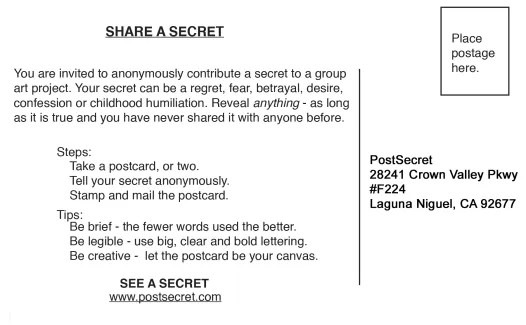
(Courtesy of Frank Warren and PostSecret.com)
The nature of the secrets sent to PostSecret varies greatly; some are humorous confessions of stealing office supplies, some are secrets about the deepest misgivings in their life, confessions of self-harm, fear, and shame. The sharing of secrets is cathartic for both the sharers and the readers: The sharer is given a platform to share their innermost thoughts anonymously, and the reader is allowed the information that other people harbour secrets as deep and meaningful as their own. One sender sent a postcard saying, “I think everybody else’s secrets are slowly but surely saving my life” This postcard acknowledges the catharsis that comes with reading others’ secrets, whilst also admitting a secret of their own.
Anna Poletti writes, “the specter of the truth claims made by the cards remains. Yet reading PostSecret as an intimate public, we can interpret the success of the project as a testament to the power of affect to drive audiences’ attachments to autobiographical modes” PostSecret functions because of the dialogue between its organiser and the community dedicated to sharing secrets. Warren’s request for authentic confessions and the community’s apparent upholding of this authenticity through creative autobiographical summaries is what makes PostSecret such a powerful and affective project.
Another artist whose work is related to privacy is Sophie Calle. “Her work consists of following people around, obsessing over them and their actions, photographing them commonly without them knowing – in their natural habitat.” Calle’s work is centred around privacy due to most of her subjects being unaware that they are the subject of an artwork. When a person is unaware they are being intently watched, they behave ‘naturally’, which creates a completely candid result. One of her works, The Address Book (2012), made in the summer of 1983, centred around her finding an address book. She sent it back to the owner, Pierre D., but not before copying every page. Without the owner knowing, she tracked down and contacted people in the address book and asked them about the owner, creating a portrait of Pierre D. without ever knowing him. She published these accounts weekly in a newspaper, and “When Pierre D. discovered Calle’s articles dissecting his life and personality, he was furious, and in return publicized a nude photograph he had found of Calle, threatening to sue her if she reproduced any of her articles in book form.”
PostSecret creates a version of the truth with the knowledge that it can and will be seen by Frank Warren, US Mail employees and potentially millions of people. This puts the candid truth at risk as people know their secrets will be seen, potentially altering the way they present their secrets. The secret being separated from the identity of the person does, however, encourage a level of candidness that allows an audience to believe in the secrets; this trust in authenticity is what makes them powerful. Sophie Calle suspends her subjects in candidness through the ritualistic obsessive following them. The fact the subject is unseen is what gives the work truthful power, allowing us to see a subject at their most natural.
My work is based around a found object; because there is no verifiable source I cannot know whether or not the letters were intentionally discarded in the charity shop, all I know is that the letters feel true to me because of: the old style of handwriting, how well they were hidden, the vulnerable content, how the books smell and feel. I wasn’t intently searching for a particular subjects secret in the manner of Sophie Calle nor was I putting an open request for secrets like Frank Warren, the secret found me through chance and other people’s goodwill. Much like Calle’s The Address Book, I have found an object in a public space containing private information, I aim to try and capture a candid picture of the secret I found without trying to paint a portrait of the subjects lives in the invasive way Calle does (Jeff and Rose are fairly regular names so I do not feel as if I am exposing an individual) or by trying to paint a portrait of the subjects by supposing things about what might’ve been. I think to give the secret the most power I should present them as I found them and set alongside them a piece of work that emphasises the truest elements to me.
Poletti, A., 2011. Intimate economies: PostSecret and the affect of confession. Biography, 34(1), pp.25-36.
Grossman, A., 2018. Stealing Sophie Calle. Suomen Antropologi: Journal of the Finnish Anthropological Society, 43(1), pp.28-35.