I first became interested in personal ephemera after finding a postcard from 1972 in a charity shop in Leicester:
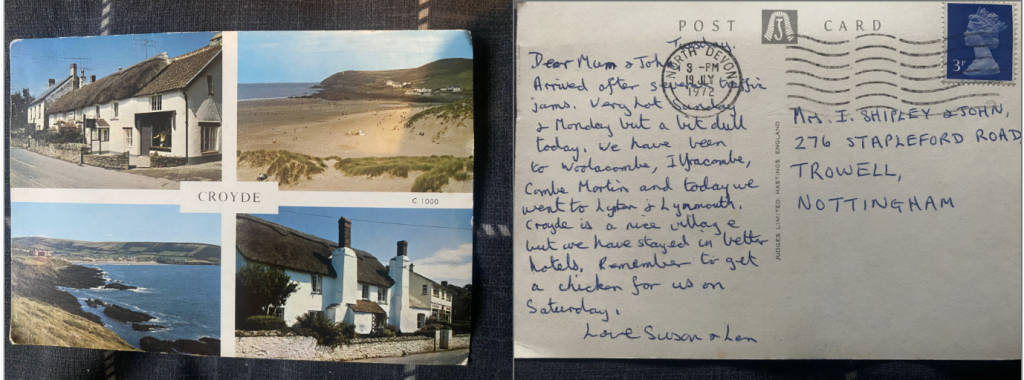
I found humour in reading Susan and Len’s 50-year-old reminder to buy a chicken for them on Saturday. Given that the request for the chicken was so old, to verify the chicken’s existence is no longer possible; however, the request for the chicken still exists, trapped in a world of complaints of dull Tuesday weather, mediocre hotels and lists of very British-sounding coastal villages, unable to reach a conclusion.
A mystique powered by personal intrigue emanated from the postcard. Though I found the message on the back to be humorous at first, I found myself left with questions surrounding the personal aspects of the message:
- Where is Dad?
- Are they still living?
- Did they buy the chicken?
All of these questions remain unresolved; there is just enough context for a reader to capture a glimmer of these people’s lives, however, not enough information to provide any answers of real substance, leaving the questions looping back on themselves.
Memory is materialised through the writing on the postcard, a short-term communication, recontextualised through the passing of time and the separation from its subjects. With the removal of context, the writing is left suspended in a mysterious, ephemeral field.
“The artists that came to be labelled hauntological were suffused with an overwhelming melancholy; and they were preoccupied with the way in which technology materialised memory – hence a fascination with television, vinyl records, audiotape, and with the sounds of these technologies breaking down.” (Fisher, 2014)
Here, Mark Fisher is stating the ways several artists (William Basinski, The Caretaker, Burial, The Ghost Box Label, Mordant Music, Phillip Jeck and more) manipulated obsolete technology and material in order to present works of art using light and sound that show a breaking down of memory and dissatisfaction with the now.
I realised after some time spent with these postcards that communications from the past form a materialisation of memory innately and can be used as material for forming an artwork that examines the nature of romantic attachment to the past and the melancholy that can come with it. I decided that I would begin to collect personal ephemera involving handwriting to use as the basis for some projects.
Fisher, Mark. Ghosts of My Life : Writings on Depression, Hauntology and Lost Futures, John Hunt Publishing Limited, 2014. ProQuest Ebook Central,