After finding a few more postcards in the charity shop, a friend who volunteered there informed me that somebody had handed in some old love letters documenting an affair concealed in small books.
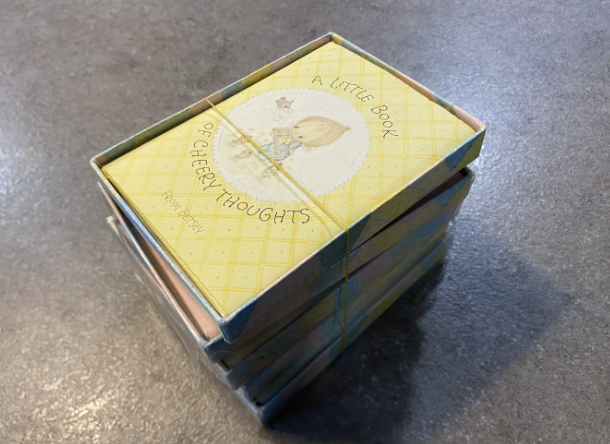
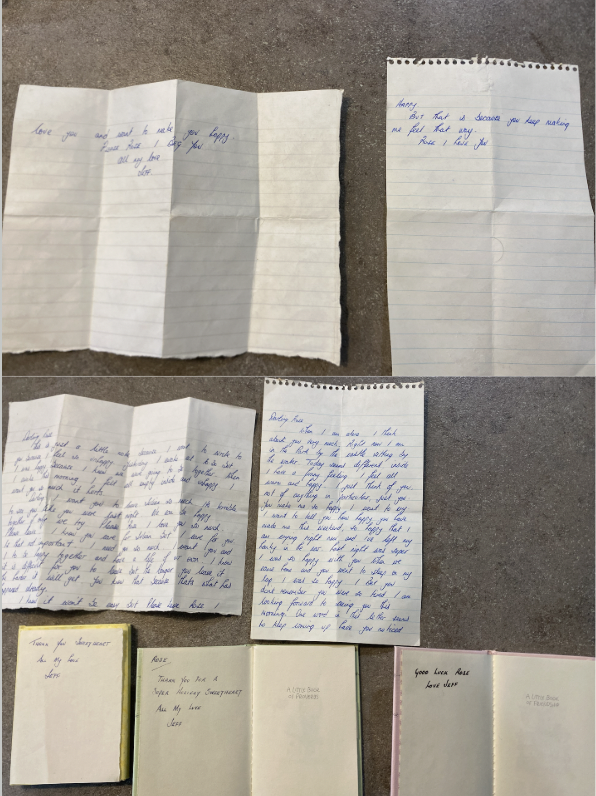
The text reads as follows:
A Little Book Of Cheery Thoughts:
Thank you sweetheart
All my love
Jeff
A Little Book Of Proverbs:
Rose,
Thank you for a super holiday sweetheart
All my love
Jeff
A Little Book Of Love:
Darling Rose
When I am alone I think about you very much. Right now I am in the park by the castle sitting by the water. Today seemed different inside, I have a funny feeling. I feel all warm and happy. I just think of you, not anything in particular, just you. You make me so happy I want to cry. I want to tell you how happy you have made me this weekend, so happy that I am crying right now and I’ve left my hanky in the car. Last night was super, I was so happy with you whe we came home and you went to sleep on my lap I was so happy. I bet you don’t remember you were so tired. I am looking forward to seeing you this morning. One word in this letter seems to keep coming up have you noticed.
Happy.
But that is because you keep making me feel that way.
Rose I love you.
A Little Book Of Nature Sayings:
Darling Rose,
This is just a little note because I want to write to you because I feel so unhappy. Yesterday I awoke at 6:30 but I was happy because I knew we were going to be together. When I awoke this morning, I felt all empty inside and unhappy. I want you so much it hurts.
Darling, I want you to leave Julian so much. It’s terrible to see you like you were last night. We can be happy together if we only try. Please Rose, I love you so much. Please leave. I know you care for Julian but I care for you. Is that not important? I need you so much. I want you and I to be happy together and have a life of our own. I know it is difficult for you to leave but the longer you leave it the harder it will get. You know that because that’s what has happened already.
I know it won’t be easy but please leave rose.
I love you and want to make you happy.
Please Rose I beg you.
All my love.
Jeff.
A Little Book Of Friendship:
Good Luck Rose, Love Jeff
I found these notes to be an interesting materialisation of memory; the vulnerability that comes with the secrecy of the letters allows for an unearthing of intense emotions that have been hidden and only rediscovered by chance, but is the unearthing of a secret like this ethical? The notes being found in a charity shop gives them a discarded quality. Who had handed them in? Jeff? Rose? Their respective children? Had the donor been aware of the lost love concealed in the books? What I assume to be the final letter gives the reader concrete information that the relationship is over; however, the non-specificity about why the lovers separated provides a mystery that is preserved in the artefact, ringing on through time, what became of these people, and do they remember the love they had?
“Art and archaeology can become much closer than they are presently, both as research practices and for experiencing, interpreting and theorising the contemporary past, pooling memory and materiality to create new and previously unforeseen views of the familiar world around us.”
To rummage around a materialisation of somebody’s private memory feels invasive; typically, the role of an archaeologist is to examine places of cultural and historical interest and suppose a narrative from the evidence they find. Taking palaeontology as an example, an archaeologist will unearth the forgotten bones of a dinosaur and take the creative liberty to piece them back together in order to suggest the way the bones of the dinosaur might have been structured. In unearthing a piece of personal history, it is hard not to think of ways in which their story might be structured; however, I aim to present the bones of this lost love as they presented themself to me. Making assumptions about the personal history of others feels dishonest to me. In the nexus of art and archaeology, especially surrounding emotional portraits of real people, honesty feels crucial; tampering with the nature of the notes and imposing my own ideas as to what might have happened would alter the truthful mystery that comes with finding an artefact so personal. The real truth only exists in memory. What I find exciting is considering what truth might have been inwardly, and creating a work that allows others to do so, too.
Schofield, J., 2009. Constructing place: when artists and archaeologists meet. In Aftermath: Readings in the Archaeology of Recent Conflict (pp. 185-196). New York, NY: Springer New York.